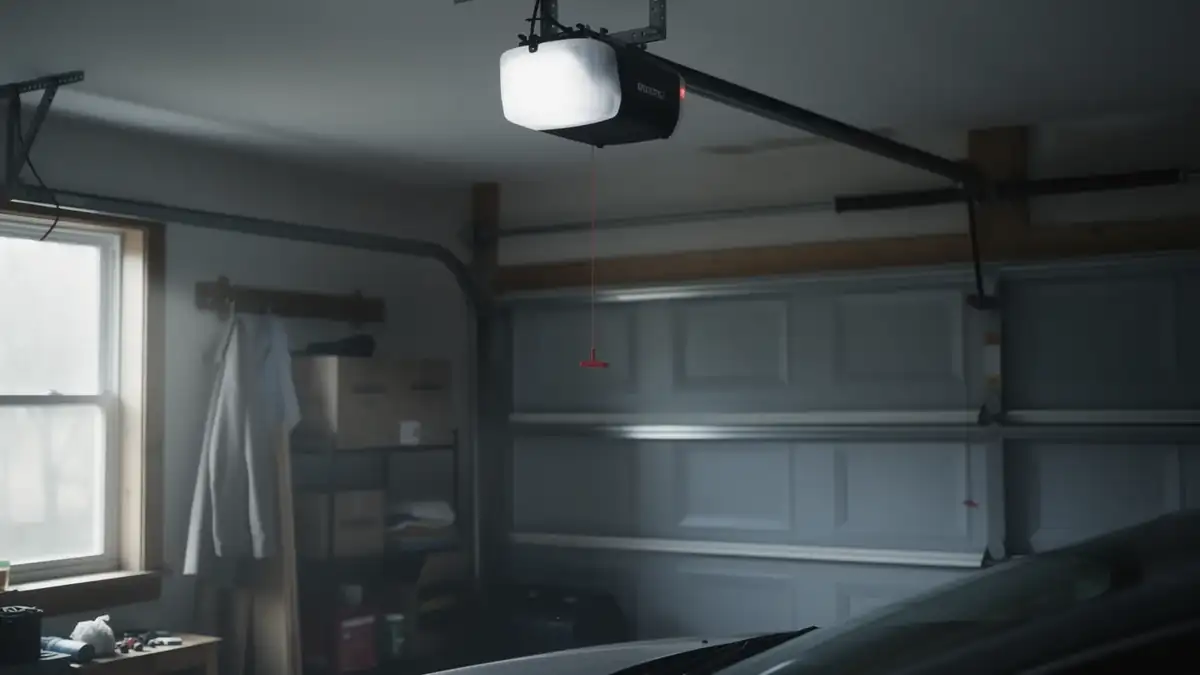
The Seasonal Bit
This area sits in a cold-moderate climate band. That doesn't mean brutal winters, but it does mean real swings - cold snaps that tighten up grease in an opener's gearbox, followed by summer heat that makes the same gearbox run hot and loud. Most garage door openers aren't built with one season in mind; they're built to handle a range, but a range this wide still wears on belts, chains, and the small circuit boards that run the safety sensors.
We see it most in late winter, when a cold morning start-up reveals a motor that's been struggling for months. The opener trips the breaker, or it runs but won't fully close, or the wall button stops responding. None of that is dramatic. It's just a machine with thirty-year-old lubricant meeting a temperature it wasn't serviced for.
The honest limitation here: we can't predict exactly when a given opener will fail from seasonal stress. What we can say is that the pattern repeats every year in this climate band, and a once-a-year check of the chain tension, the sensor alignment, and the gear housing catches most of it before a cold morning turns into a stuck door.
What You Pay
We don't post a flat number for opener work because what drives the job is age and what's already failed
Not the town you live in. A sensor realignment is a different call than a stripped gear or a dead circuit board, and a house built in the 1980s or 90s - which covers most of the stock in this service area - is more likely to need the second kind of job than a house built last year.
What we can tell you is what tends to drive the bill up
A motor that's seized rather than just slow, a logic board that's fried rather than glitching, and a chain-drive system versus a belt-drive, since parts availability differs. If your opener is original to a house built decades back, replacement parts for that specific model may simply not exist anymore, which pushes the conversation toward a full unit swap instead of a repair.
At a median household income of $64,756 across this area
Most homeowners we talk to are trying to get one more good decade out of an opener rather than upgrade for the sake of it. That's a reasonable goal for most units still running fine - just not for one that's already stalling in the cold.
- $64,756 median household income
The Problem
Most houses in this service area went up between 1967 and 2004, with the heaviest concentration in the 1980s and 90s. That means a lot of garage door openers out there are original or close to it - units now pushing twenty to forty years old, built before modern battery backup and rolling-code security were standard.
The practical problem shows up during a power cut. An opener from that era has no battery backup, full stop. When the power goes, the door is stuck in whatever position it was in - closed if you're lucky, half-open if you weren't. Newer openers include a battery backup as a standard feature specifically for this. Swapping an aging unit for one with backup isn't about chasing new technology; it's about closing a real gap that a thirty-year-old opener simply doesn't cover.
Across the twelve communities we cover, from East Cleveland two miles out to Sale Creek nineteen miles out, that same era of construction repeats. It's not a one-house problem. It's a housing-stock problem, and it's worth checking your opener's age against your last outage before the next one.
How Local Conditions Play In
With 15,036 owner-occupied houses in this service area, a lot of garage doors share the same bones: openers and tracks installed when the house was built, in a construction window that runs 1967 to 2004. Put that alongside a cold-moderate climate and you get a specific failure pattern - not catastrophic, but steady. Cold mornings stress old gearboxes. Outages leave aging openers with no backup stranded mid-cycle. Neither problem is unique to any one street; it's baked into when and how this part of the area was built.
The fix isn't complicated, but it does take an honest look at what you've got. If your opener predates battery backup as a standard feature, that's worth addressing before winter, not after a morning you're stuck. If it's a chain-drive unit from the 80s or 90s straining through July heat, a tune-up now beats a stripped gear later.
We work across this service area, including the towns closest in like East Cleveland, Hopewell, and South Cleveland, and further out toward Benton and Ooltewah. The housing era and climate band are consistent enough across that range that the same checks apply almost everywhere we go.